Sunday, June 28, 2020

Living In Difficult Times


“And you will hear of wars and threats of wars, but don’t panic.” – Matthew 24:6(a)

These are difficult and tumultuous times. They leave many feeling that things are… out of control. Some feel that something is slipping away. Others feel that change may never come. Times like can lead us to as, “Why?” “Who is responsible?” “When will this end?” I am convinced that these are the wrong questions. I am persuaded that there is no one… or one group… responsible for what is going on. There is no great reason why. Rather, all that is happening is the natural playing out of history – the result of trillions of decisions being made by billions of individuals playing out against the laws of nature. So, does that mean that I think we are helpless, being tossed about by impersonal forces with rhyme or reason? God forbid!

I believe that there is One who has promised to be with us, no matter what, forever. This One – God, as fully revealed in Jesus Christ – walked through difficult and tumultuous times Himself. At the end of His journey on Earth, he promised His followers, and us that He would never abandon us:

“And be sure of this: I am with you always, even to the end of the age.” – Matthew 28:20(b)

Jesus not only gives us a promise – that He will be with us no matter what happens – but also an example of how to respond to these times.

How did Jesus respond to the times in which He lived? Many of His followers expected at various times that He would make a grab for power – after all, they knew, as many still believe, that gaining and holding power is how you get things done. Yet, Jesus never made that power grab. Instead, He preached deliverance to the oppressed, freedom to the captive and forgiveness to the sinner. He healed the sick, gave sight to the blind and fed the hungry. He loved. He did not demand that people change to be fed, healed, or loved; rather He let them be changed by the impact He had on their lives. And, perhaps most shockingly, He did not reserve His love for those like Him – those who shared his religious tradition, ethnic identity, morality or skin color – rather He reached out again and again to those His culture told Him were the enemy. And what’s more, He told us to do the same:

“I have given you an example to follow. Do as I have done to you.” – John 13:15

A few years ago, the expression “What Would Jesus Do” – abbreviated WWJD – was in vogue in Christian circles. Unfortunately, it has been rather widely mocked as an example of shallow piety. However, at its core, WWJD asks the most pertinent question a follower of Christ can ask him or herself. So, what would Jesus do in our difficult tumultuous times? He would love. Even those who are unlovable. He would listen to people to understand their needs and He would address those needs. I am pretty sure He would encourage His followers to do what is best for others, to think more of the welfare, physical and mental, of other people, rather than worry about their personal interests or “rights”. I am also quite sure that He would not share conspiracy theory memes on social media, trying to blame those He disagreed with for all the world’s problems. Instead, He would be busy helping those in need of His help. And, did I mention that He would love?

“Then Jesus said, ‘Yes, now go and do the same.’” – Luke 10:37(b)

Full passages and context of verses quoted above:

Matthew 24:3-8: Later, Jesus sat on the Mount of Olives. His disciples came to him privately and said, “Tell us, when will all this happen? What sign will signal your return and the end of the world?” Jesus told them, “Don’t let anyone mislead you, for many will come in my name, claiming, ‘I am the Messiah.’ They will deceive many. And you will hear of wars and threats of wars, but don’t panic. Yes, these things must take place, but the end won’t follow immediately. Nation will go to war against nation, and kingdom against kingdom. There will be famines and earthquakes in many parts of the world. But all this is only the first of the birth pains, with more to come.

In this passage, Jesus answers His disciples when they ask for signs of the Second Coming and of the End of The World. I believe that taken as a whole Jesus’ answer means that we should not engage in idle speculation about such things. We should not wring our hands and worry or panic about whether or not we are living in the “End Times”. Rather, I believe that Jesus is telling us to be busy doing His work and trust in Him no matter what “signs” we see or think we see.

Matthew 28:18-20: Jesus came and told his disciples, “I have been given all authority in heaven and on earth. Therefore, go and make disciples of all the nations, baptizing them in the name of the Father and the Son and the Holy Spirit. Teach these new disciples to obey all the commands I have given you. And be sure of this: I am with you always, even to the end of the age.”

Jesus’ Great Commission.

John 13:12-17: After washing their feet, he put on his robe again and sat down and asked, “Do you understand what I was doing? You call me ‘Teacher’ and ‘Lord,’ and you are right, because that’s what I am. And since I, your Lord and Teacher, have washed your feet, you ought to wash each other’s feet. I have given you an example to follow. Do as I have done to you. I tell you the truth, slaves are not greater than their master. Nor is the messenger more important than the one who sends the message. Now that you know these things, God will bless you for doing them.

At the Last Supper, Jesus washed His disciples’ feet in a sign of humility and service. He commanded them – and us – to do likewise.

Luke 10:36-37: Now which of these three would you say was a neighbor to the man who was attacked by bandits?” Jesus asked. The man replied, “The one who showed him mercy.” Then Jesus said, “Yes, now go and do the same.”

This is the end of the story of The Good Samaritan: A man is beaten and robbed and left to die on the road. Two religious leaders pass the man by and do nothing. Finally, a Samaritan – an outcast outsider and heretic to Jesus’ listeners – stops and helps the man.

Sunday, April 2, 2017

Religion and Politics, Oh My


Religion and politics. There are few quicker ways to start an argument or spoil a casual social encounter than to raise religion and politics. Nevertheless, there are many who espouse the idea that the two are intrinsically linked. On the other hand, equal numbers wish to keep the two separate and apart in every way.

So, why am I wading into these deep and turbulent waters? I can assure you that it is not an attempt to divine from holy writ that one major party or the other is righteous in all it does or that the other is vile in all its deeds. Nor is my attempt to label any particular leader either a modern-day Cyrus (much less a modern-day David) or a Satan incarnate.

Rather, I do believe that as people of faith Christians are called to live their faith in all aspects of their lives, including their political choices and their relationship with their government, regardless of their country of residence or citizenship. Therefore, I thought it worthwhile to spend a little time this Sunday, the day before Opening Day (which should be a holiday, by the way), looking at what God has to tell us through the Bible about faith and civics.

To begin, as I look through the Bible, I notice that it actually has quite a bit to tell us about how we as Christians and followers of Christ should relate to the government. 

First, Scripture tells us that we should respect the civil authorities because they are ordained by God.
“Let everyone be subject to the governing authorities, for there is no authority except that which God has established. The authorities that exist have been established by God.
‎Consequently, whoever rebels against the authority is rebelling against what God has instituted, and those who do so will bring judgment on themselves.

‎”For rulers hold no terror for those who do right, but for those who do wrong. Do you want to be free from fear of the one in authority? Then do what is right and you will be commended.

‎”For the one in authority is God’s servant for your good. But if you do wrong, be afraid, for rulers do not bear the sword for no reason. They are God’s servants, agents of wrath to bring punishment on the wrongdoer.

‎”Therefore, it is necessary to submit to the authorities, not only because of possible punishment but also as a matter of conscience.” – Romans 13:1-5

“Submit yourselves for the Lord’s sake to every human authority: whether to the emperor, as the supreme authority, ‎or to governors, who are sent by him to punish those who do wrong and to commend those who do right. ‎For it is God’s will that by doing good you should silence the ignorant talk of foolish people. 

‎
“Live as free people, but do not use your freedom as a cover-up for evil; live as God’s slaves. ‎Show proper respect to everyone, love the family of believers, fear God, honor the emperor.” – 1 Peter 2:13-17

To be clear, I find nothing that tells us we should always agree with the civil authorities or that they are always right, but they are always deserving of our respect. Keep in mind that 1 Peter was written during a period of persecution. In effect, Peter is telling the church to submit to and respect the very authorities who are persecuting them.

In addition, Christians are admonished to pay their taxes. I take the spirit of this teaching one step further and argue that God wants us to do our civic duty, whether that is paying taxes, performing public service or just being a good citizen.

“This is also why you pay taxes, for the authorities are God’s servants, who give their full time to governing. ‎Give to everyone what you owe them: If you owe taxes, pay taxes; if revenue, then revenue; if respect, then respect; if honor, then honor.” – Romans 13:6-7

As many of you already know, we are also called upon to pray for those in authority in the government.

“I urge, then, first of all, that petitions, prayers, intercession and thanksgiving be made for all people—‎for kings and all those in authority, that we may live peaceful and quiet lives in all godliness and holiness. ‎This is good, and pleases God our Savior, ‎who wants all people to be saved and to come to a knowledge of the truth.” – 1 Timothy 2:1-4

As with the earlier command to respect the civil authorities, I see no caveats here that make it acceptable to pray only for those leaders we agree with or voted for, or to pray only that those we disagree with amend their ways, come over to our point of view or resign.

So, what do we do when we disagree with the civil authorities? First, I think we look at the repeated pleas of Paul and the other New Testament writers to lead exemplary lives. Like Joseph or Daniel, we should impress those in authority – and others who may be watching us – with the way we live our lives, rather than the volume of our complaints or the ferocity of our denunciations.

However, if the time comes when the orders of the civil authorities clearly violate what we have been called to do as Christians, Scripture offers a model: that of the Apostles and the early Church.

“Then they called them in again and commanded them not to speak or teach at all in the name of Jesus. 

‎"But Peter and John replied, ‘Which is right in God’s eyes: to listen to you, or to him? You be the judges! ‎As for us, we cannot help speaking about what we have seen and heard.’

‎"After further threats they let them go. They could not decide how to punish them, because all the people were praising God for what had happened.”‎ - Acts 4:18-22

In this passage, the Apostles are confronted with an order from the legitimate authorities. Yet, this order – to stop proclaiming the Gospel – clearly flies in the face of the command that they received from Jesus Himself. So, the Apostles chose to obey God and defy the civil authorities. However, what is important to note here is that they were prepared to accept the consequences of their disobedience. Peter and John explicitly state that the authorities must judge them according to what they see as right. In this case, they escaped without punishment. However, for all of them, except for John, their obedience to God eventually led to their deaths. For many of them, like Peter and Paul, their deaths were not murders or extrajudicial killings, as we might say today, but were lawful, government-sanctioned executions. 

Throughout the first two centuries of the Church, and still today in some places, obedience to God could lead to disobedience of the civil authorities. Nonetheless, the early Christians held fast to the teachings of the Apostles and remained respectful of and as obedient to the civil authorities as they could. The early Christians did not revolt, raise an insurrection, or stockpile weapons. Rather, they obeyed both God and the civil authorities when they could, and when they had to choose, they chose obedience to God while accepting the consequences of their disobedience to the civil authorities. 

Now, let’s take a look at what the Bible has to say about the role of the government. To be honest, it is difficult to find references to “government” in the Bible, particularly the Old Testament; however, it is possible to find references to the role of the king. Considering that, at the time, the king was synonymous with government and government without a king was nearly inconceivable – see the Israelites’ pleas to replace the judges with a king – I decided to look at what Scripture tells us about the role of the king and to apply that to modern government.

‎"The lips of a king speak as an oracle, ‎and his mouth does not betray justice.
‎Honest scales and balances belong to the Lord; ‎all the weights in the bag are of his making.
Kings detest wrongdoing, ‎for a throne is established through righteousness.
‎Kings take pleasure in honest lips; ‎they value the one who speaks what is right.”
– Proverbs 16:10-13
“‎By justice a king gives a country stability, ‎but those who are greedy for bribes tear it down.
If a ruler listens to lies, all his officials become wicked.
If a king judges the poor with fairness, his throne will be established forever.”
– Proverbs 29:4;12;14
‎”Do not exploit the poor because they are poor ‎and do not crush the needy in court,
‎for the Lord will take up their case ‎and will exact life for life.”
– Proverbs 22:22-23*

‎”Do not move an ancient boundary stone ‎or encroach on the fields of the fatherless, ‎for their Defender is strong; ‎he will take up their case against you.”
– Proverbs 23:10-11*
* While these two passages don’t explicitly reference the king,
they are written as advice from Solomon, the king, to his son,
the future king.

First, note how much these few verses focus on just a few topics: honesty, justice, fairness, and the treatment of the poor. The king is called up to do justice, with particular emphasis on ensuring that poor are not railroaded by the rich and are treated fairly. 

Now, for a few particulars. The king is enjoined to ensure that scales and weights are honest. This is essentially a command to regulate the markets to ensure that sellers do not take advantage of buyers with unfair measures. 

The king is expected to respect the ancient boundary markers to ensure that the powerful do not encroach on the land that the poor and defenseless relied on their survival. Makes me wonder about what this has to say about the use of eminent domain to, say, seize someone’s home so that a developer can build a higher value commercial complex.

The king is called upon to create stability by governing with justice and eschewing corruption. The old phrase, “Being above the appearance of wrong doing,” comes to mind. Having lived in many countries, I can attest how different it is live in a country where the government generally acts with integrity, compared with those where every government action hides someone’s personal ulterior motive.

Finally, the king is cautioned to be honest and not to lie, to prevent his officials from growing wicked in the shadow of his own deceitfulness. As they say, “A fish rots from the head down.” How often has that proven true in the world of politics?

Act with justice. Ensure fairness. Protect the poor and powerless. Promote honesty and stability. Reject deceit and corruption. That sounds like a recipe for good government to me.

Sunday, May 1, 2016

Random Thoughts on a Sunday in San Salvador


El Salvador uses the U.S. Dollar for its official currency. It makes it easy for us Americans living here – it’s the first place I’ve served overseas where I don’t need to worry about exchange rates (though I do miss having the opportunity to collect a few samples of an “exotic” foreign currency).

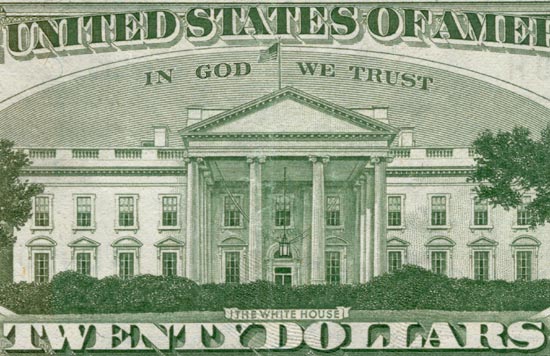
This morning, however, for no particular reason, I was thinking about the motto on our currency: In God We Trust.

Image courtesy of Wikipedia.


Since I was a boy, a long time ago, there have been those calling for the removal of the motto from our currency, saying that it is incompatible with the separation of Church and State. Those opposed to the motto point out, correctly, that it was not adopted by Congress until 1956– at the height of the Cold War – as a means of differentiating us from our Communist foes. They also note that it did not appear on paper currency until 1957. Supporters of the motto point, correctly, to its history before the Cold War. A variation of the slogan – “And this be our motto: In God is our Trust” – was first penned by Francis Scott Key in the fourth stanza of the Star Bangled Banner. It first appeared on U.S. coins in 1864 and has been there, off and on, since.

My point today, however, has nothing to do with that controversy.

As I looked at the motto on my dollar coin this morning, I found myself thinking, which god it is speaking about. Is it referencing the one, true Trinitarian God – Father, Son and Holy Spirit? The God who inspired these words:

  • Whoever loves money never has enough; whoever loves wealth is never satisfied with their income. (Ecclesiastes 5:10)
  • Come, all you who are thirsty, come to the waters; and you who have no money, come, buy and eat! Come, buy wine and milk without money and without cost. (Isaiah 55:1)
  • Her leaders judge for a bribe, her priests teach for a price, and her prophets tell fortunes for money. Yet they look for the Lord’s support and say, “Is not the Lord among us? No disaster will come upon us.” (Micah 3:11)
  • No one can serve two masters. Either you will hate the one and love the other, or you will be devoted to the one and despise the other. You cannot serve both God and money. – Jesus, in Matthew 6:24
  • For the love of money is a root of all kinds of evil. Some people, eager for money, have wandered from the faith and pierced themselves with many griefs. (1 Timothy 6:10)

Or is it another, false god?

To be clear, I don’t have any problems with money – and I don’t believe that God does either. Money has its uses and purposes. But the pursuit of money, the driving greed to have more and more, is a disease of the soul. My name for this disease is: Materialism; an older name for it is: Mammon.

Unfortunately, in the world today, it is an all too common disease. One that afflicts both the rich (who often scramble to add more “stuff” – more things – to their trove, as if life is a competition and the one who dies with the most toys wins) and the poor (who often crave what the wealthy have – who want their piece of that pie). It afflicts the atheist and the Christian alike. It is disease that can afflict all of us and probably does afflict most of us from time to time, myself included.

So, the next time you look at your coin and read “In God We Trust”, consider which god are we trusting in as a nation, a world, an individual? Are we trusting in the God who says, “And why do you worry about clothes [comment: or perhaps any other material possession]? See how the flowers of the field grow. They do not labor or spin. Yet I tell you that not even Solomon in all his splendor was dressed like one of these.” Or are we trusting in Mammon, the god of money and materialism?