El Salvador uses the U.S. Dollar for its official currency.
It makes it easy for us Americans living here – it’s the first place I’ve
served overseas where I don’t need to worry about exchange rates (though I do
miss having the opportunity to collect a few samples of an “exotic” foreign
currency).
This morning, however, for no particular reason, I was
thinking about the motto on our currency: In God We Trust.
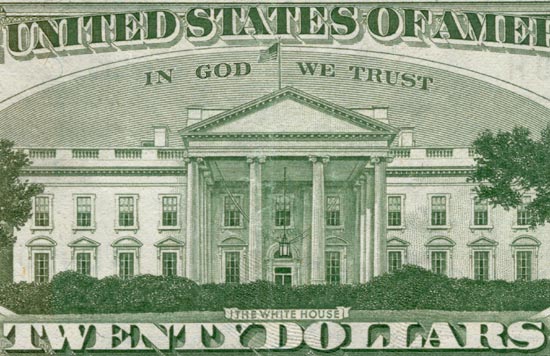
Image courtesy of Wikipedia.
Since I was a boy, a long time ago, there have been those
calling for the removal of the motto from our currency, saying that it is
incompatible with the separation of Church and State. Those opposed to the
motto point out, correctly, that it was not adopted by Congress until 1956– at the
height of the Cold War – as a means of differentiating us from our Communist
foes. They also note that it did not appear on paper currency until 1957.
Supporters of the motto point, correctly, to its history before the Cold War. A
variation of the slogan – “And this be our motto: In God is our Trust” – was first
penned by Francis Scott Key in the fourth stanza of the Star Bangled Banner. It
first appeared on U.S. coins in 1864 and has been there, off and on, since.
My point today, however, has nothing to do with that
controversy.
As I looked at the motto on my dollar coin this morning, I
found myself thinking, which god it is speaking about. Is it referencing the
one, true Trinitarian God – Father, Son and Holy Spirit? The God who inspired
these words:
- Whoever loves money never has enough; whoever loves wealth is never satisfied with their income. (Ecclesiastes 5:10)
- Come, all you who are thirsty, come to the waters; and you who have no money, come, buy and eat! Come, buy wine and milk without money and without cost. (Isaiah 55:1)
- Her leaders judge for a bribe, her priests teach for a price, and her prophets tell fortunes for money. Yet they look for the Lord’s support and say, “Is not the Lord among us? No disaster will come upon us.” (Micah 3:11)
- No one can serve two masters. Either you will hate the one and love the other, or you will be devoted to the one and despise the other. You cannot serve both God and money. – Jesus, in Matthew 6:24
- For the love of money is a root of all kinds of evil. Some people, eager for money, have wandered from the faith and pierced themselves with many griefs. (1 Timothy 6:10)
Or is it another, false god?
To be clear, I don’t have any problems with money – and I
don’t believe that God does either. Money has its uses and purposes. But the
pursuit of money, the driving greed to have more and more, is a disease of the
soul. My name for this disease is: Materialism; an older name for it is:
Mammon.
Unfortunately, in the world today, it is an all too common
disease. One that afflicts both the rich (who often scramble to add more “stuff”
– more things – to their trove, as if life is a competition and the one who dies
with the most toys wins) and the poor (who often crave what the wealthy have –
who want their piece of that pie). It afflicts the atheist and the Christian
alike. It is disease that can afflict all of us and probably does afflict most
of us from time to time, myself included.
So, the next time you look at your coin and read “In God We
Trust”, consider which god are we trusting in as a nation, a world, an
individual? Are we trusting in the God who says, “And why do you worry about
clothes [comment: or perhaps any other material possession]? See how the
flowers of the field grow. They do not labor or spin. Yet I tell you that not
even Solomon in all his splendor was dressed like one of these.” Or are we
trusting in Mammon, the god of money and materialism?
